
Tiger-Cats offensive lineman Jason Jimenez was one of seven CFL players that took part in Huddle For Haiti, a CFLPA, WestJet and Oxfam Canada driven initiative that supports Haiti relief one year after the devastating earthquake. Jimenez recently returned from his 10-day visit to Haiti and has shared his thoughts on the experience in a series of stories on Ticats.ca. His final entry is below…
—
In my past three articles, I’ve described – as best I could – the feelings I had during our trip, as well as some of the events we participated in. What has been hardest to put into words, and therefore I have not yet mentioned, have been the physical devastation of the country and the sickness and disease spread throughout the island. I am going to try my best to discuss that here.
Perhaps the most iconic and representative devastation is the damage visible to presidential palace. Looking at a before and after photo of the palace is incredible. It almost looks like a Ripley’s Believe it or Not-so-funhouse. It looks as though the palace, once magnificent and well manicured, just crumbled. Perhaps expectedly, as this is, after all, the aftermath of an earthquake..
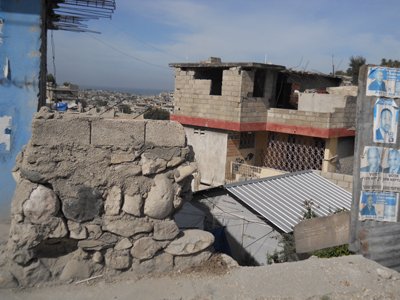
In fact, almost all of the physical structures – homes, restaurants, office buildings, etc. – look and carry on this way. Almost. While some buildings were reduced to rubble, adjacent buildings have few visible signs of structural damage. It doesn’t make much sense; when looking at a city block, one will notice that while four or five homes have been destroyed, the others remain completely intact. Mother Nature both reduced people’s living spaces and created new makeshift parcels of real estate, all at the same time. And as so many homes were reduced to rubble, Haitians have had no choice but to live in tents amongst the remaining rubble. A year later these tent cities, which should have been a temporary living solution, still dot the landscape. Unfortunately, with the current political situation and the poverty of the country, there is no end in sight as to when these communities will dissolve.
Looking at the devastation, the rubble, the living conditions and the tent cities, one might assume that the physical calamity of the earthquake destruction would lead to a demoralization of the effected inhabitants. This, however, couldn’t be further from the truth. While we may think that living in such conditions would be a humbling experience for many Haitians, you wouldn’t get that sense from seeing them today. While many live in temporary living conditions, they are all (yes, all) dressed very well, all of the time. They wash everything by hand, and to be honest, even with my washing machine and fancy detergents, I’ve never knew fabrics could be so bright! Haitians carry themselves with pride and dignity, despite their environment and conditions. It was inspiring to witness.
While the Haitians live amongst these conditions on a daily basis, it was, of course, new to us, and therefore along with the new conditions we’d be experiencing were a new set of fears and concerns. The unmentionable, yet constant worry that we all had while in Haiti was of getting sick. We weren’t allowed to leave for Haiti before updating our vaccinations and making sure we had ample supplies of medication in case anything went wrong. Fortunately for us, everything went well. Some in our group experienced mild food related illnesses, but nothing serious. A huge concern for both residents and visitors alike is clean drinking water. We were told from before we ever landed in Haiti, “don’t drink the water.” Understandably so, Haiti’s fresh water supply isn’t so fresh to say the least. Part of our vaccination checklist included an inoculation for the non-endemic disease of cholera. Depending on whom is asked; cholera’s origins in Haiti will incite a furious and curt response. Haitians believe it was transmitted via UN peacekeepers from Nepal.
The conspiracy theory is that cholera was introduced in Haiti to commit a silent genocide. While this might sound far-fetched to us, it is easy to see why the Haitians may fall to this conclusion: more than 1,500 people have died from cholera since October 2010. I failed to photograph them, but many UN barracks scattered across Port au Prince have “UN=kolera” spray painted on their walls. Whether the allegations are true or not, what is true is that without access to a clean water supply and amongst the rubble and widespread debris, cholera is spreading throughout the country and taking lives with it.
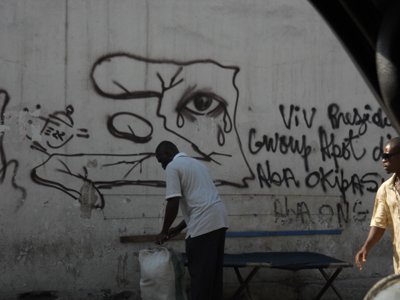
As I mentioned above, we were fortunate to be well vaccinated, and none of the Huddle got sick while on the trip, which was great because it allowed us to spend our time as healthy volunteers and to put our services to work.
Perhaps the most impactful day we had was towards the end of the week, when we met up with Oxfam International at a location a few kilometers from the epicenter of the earthquake. The location of a leveled tuberculoses hospital would now be the sight of a sanitation facility equipped with makeshift latrines and washing stations. Our task was to assist in digging trenches that would later house the piping and irrigation tubes for the sanitation facility.
This project proved to be the physically hardest one of all. It was hot, and the work made it seem like a two-a-day football practice. I’m not sure how many cubic meters of earth was moved that morning, but Oxfam was definitely appreciative of the helping hand that we gave them in moving forward with this essential project. We only wish we had more time and more resources to do more.
I’m still left wondering how it is that Haiti is still able to move forward after such a shift in physical and social landscape. I cannot convey all of our experiences or my thoughts in these four articles, but I hope that I’ve been able to give you an idea of what we experienced and what Haitians are living with today. For me, the message that we received from the Haitians is clear: life happens—never give up, no matter what. This is what I’ve taken away from the whole experience. This is what I wish to convey. If a small, destitute island with 90% unemployment can lift their heads high and move forward, anyone can.
Note – to see all of the photos of the trip, “Like” me on Facebook.
